Family camping

We spend all our family vacations camping, out of both necessity and preference. Necessity, because we have four kids, and there’s no way we can afford three weeks in high season in a hotel. Preference, because both my wife and I grew up this way.

We’ve come to view camping as a skill, and that’s what I want to talk about today. When you search YouTube for camping advice, the videos you find fall into two broad categories: Folks telling you how to find the best 100.000€ RV, and folks telling you how to survive in the forest with nothing but a Swiss army knife and a pair of shoelaces.

Unsurprisingly, neither category is a good fit for how we spend our vacations. Yet I suspect there’s more people like us out there: Rich enough to afford vacations, not rich or boring enough for hotels, and more interested in a simple, relaxing experience than in material comforts. I see some of those families out here on this campsite right now.

Camping, especially with kids, is a bit of a craft really. Your equipment slowly grows over the course of years, and you build skills. I want to share what we’re doing, and what we’re using, in the hope of helping others (especially families) to have more, and more relaxing, times together.

Accomodation

Having four kids, in an environment where everything is designed for families with two or three children at most, means we often need to go a bit bigger than others. As the core of our camping setup, we’re using a Trigano Odyssee folding caravan. It’s a smallish trailer that we hitch to our car, and that folds open into a comfortable tent for four people — if need be, it can sleep up to eight, though I wouldn’t advise trying that. Ours is from the late 90s, and cost us 1200€ when we bought it in 2012, from the sort of people who call the police on parking offenders, so it was in great shape. It’s starting to show its age though.

These days, it’s where us parents and the two younger kids sleep. The two older kids get a separate 3 person tent to themselves. In addition, we have a shelter (3.5 x 3.5m) for rain protection, and a large tarp (4x5m or something) for shade.

All this gives us plenty of room for sleeping and luggage. It’s perfect as long as the weather is good. On rainy days, we can retreat to the tents and the shelter; the tarp can’t take very much wind, and sometimes needs to be hauled in.

The trailer also is where we store our camping tables and chairs. When we set up, they go under the tarp or in the shelter, depending on the weather.

Cooking & eating

We used to have a foldable kitchen cabinet that we would set up inside the shelter, with a two-flame gas stove. But last summer, I finally got round to building a shelf for the trunk of our van (a Renault Trafic). It’s designed for Euro containers, and has space for the stove, too. This makes organizing the kitchen a lot easier.

So we cook in the back of the car, using a gas bottle stood next to it. Supplies and kitchen gear are stored in the Euro containers. Meals tend to be simple. Cooking and cleaning duties are distributed among the fanily members in pairs, on a rotating basis. These days, all of the kids are old enough to handle all of the tasks: Cooking, washing dishes, shopping.

A couple of years ago we invested in a proper cooler, and it’s doing a great job.

Entertainment

There’s a beach just 50m away. In the trailer, we have various geological strata of toys and gameas for different age ranges. We play board and card games together.

We always carry a large inflatable canoe, a Gumotex Scout. Often, we take an inflatable standup paddle board along as well. Since we’re a kayaking family, there might be some additional boats, but that’s just us.

Oh, and we have at least three hammocks strung up, if at all possible. The family consensus is that we’re here to chill. Whenever someone gets itchy feet — usually it’s me — they can just devise some activity, and head out on their own. For example, I love hiking, or going on overnight kayaking trips. The rest of the family, not so much.

Advantages and limitations

This setup is good for stationary vacations in sunny climes. Pick a nice spot, drive there, set up, and stay for 2-3 weeks. It certainly wouldn’t work well for families who would like to move somewhere else every few days. We’ve actually spent our vacations in the same campsite for the past decade.

OK, it does lack novelty. But when we arrive, the kids jump out of the car and start scouting to see whether our favorite spots are available. They check whether their favorite greengrocer is working, and which of our acquaintances are there. There’s hardly any stress. Everyone knows what to expect, and it works for us.

Of course, we depend on drinking water and power being available. Toilets and showers are nice, too. But that’s true for pretty much any place where you plan to spend significant time, especially with kids. We’re set up for campsites, not for the wilderness.

Our way of camping is far from basic, but lacks various things that I see our neighbors use: air conditioning (heat waves are a problem), TV, and so forth. We don’t miss any of it.

Conclusion

This setup, built over the years with growing experience, works really well for us. We constantly find details to improve; but the key components are pretty much fixed.

No doubt things will change when the kids grow older, and our vacation team dwindles in number. That’s fine, we’ll adapt. But for now, we’re happy with what we have. It’s enough.

Daily practice (kayaking edition)

I’ve discovered the benefits of daily practice. Quite possibly as the last
human being on Earth, I’ve found out that doing something every day makes you
get better at it.

A few weeks ago, I took a course to learn some basics of freestyle kayaking. At
the moment, I’m not really interested in learning how to run more difficult
whitewater sections. Instead, I want to do more fun stuff on the bits of river
where I already feel comfortable. In my case, “fun stuff” means getting my boat
vertical, pirouetting on the stern, sliding along rocks, and jumping over them.
(Short plug: the kayak school, Outdoordirekt is excellent. Great concept, run by a woman, LGBTQ+ friendly. If you’re in or near Germany and want to learn kayaking, or improve your skills, they’re a great choice.)

Now I’m on a two-week camping vacation on the beach, with my family. The kids
are no longer little, and even though there’s four of them, it’s a very chill
affair. For the first time in literal decades, I can actually decide pretty
freely what I want to do with my day. In fairness, the answers I find tend to
include the words “hammock” and “cold beer” quite frequently.

But I brought a little boat along. It’s a Dagger Centrifuge –
something called a “rodeo boat” when it came out in the mid-2000s. It’s longer
than today’s playboats, but its flat front and stern mean that it performs well
beyond just freestyle waves. You can actually paddle this down a river. The
trade-off is that it’s not quite as easy to get vertical, because the ends have
air in them, and therefore like to float.

Most days during this vacation, I’ve been taking the little boat out for
flatwater practice: Freestyle moves that don’t rely on current to push the
boat, only on the paddler’s technique. It’s honestly a bit frustrating: I know,
in theory, how most of this stuff should work. But in practice, getting all the
little details riight turns out to be supremely difficult. For these moves, you
need exact, sub-second timing on where you put your weight, how you rotate your
body, where you put your paddle and where you move it, and how you manage the
boat’s edges. Get any of these factors wrong, and the move won’t work.
Maddeningly, a lot of the details must be executed exactly opposite to what
I’ve been taught as “proper whitewater technique” for a decade.

Despite the occasional frustration, I’ve now gone out on the water almost every
day for a week, and some things are actually starting to work! I’ve learned to
do Lean Cleans – rotating the boat in a flat circle, without using the paddle! This is an
important foundation for other freestyle techniques. My stern squirts are finally
beginning to work, though I have yet to succeed at turning them into a stern
stall (ie. not just getting the bow up in the air, but actually holding the
boat vertical).

Of course, the technique I’m actually improving most is my roll. A lot of
times, the move fails, and I just tip over. But then, a kayaker can never have
too much rolling practice. All those freestyle moves require significant core
strength, especially if you have to compensate for less-than-perfect execution;
so I get a free core workout with my kayak sessions!

My progress isn’t rapid by any means. I keep having to dial back when
practicing a move, focusing on an easier version or a foundational element
first, before trying again to string all the little bits together. I get
frustrated. When I’m tired, I notice that the moves work significantly less
well than at the beginning of the session.

And yet. Every day, something works a little better. The Lean Cleans, a
challenge at the beginning, have become almost effortless. On the stern
squirts, I can now focus on the finer details, instead of just struggling with
the basics. Sometimes I try a new move, and notice the learning curve ahead.

I’m finally realizing that that learning curve is actually the point.
Everyone thinks the goal is to execute the move I want, perfectly, whenever I
want to; hell, I certainly thought so. But it just became clear to me that I’m
out on clear, turquoise water, in a beautiful corner of the world, with people
I love, and without any pressure. I’m doing something that I’m passionate
about, with no conceivable profit motive — exclusively for the fun of it! (OK,
some of the toddlers at the beach think I’m pretty cool.)

Call me silly, but I feel like I’ve just invented the practice of having fun.

Read: Captains of the Sands

Last night I finished re-reading one of my favorite books from my youth: Captains of the Sands (Capitães da Areia), by Jorge Amado. Published in 1937 in Brazil, the story follows a gang of street children in Salvador de Bahia. The boys sleep in an abandoned storehouse, and live by stealing and begging.

I found the book extremely gripping now, just as I did when I was young. Amado’s perspective relentlessly stays with his protagonists. The rich people and the police are sometimes antagonists, but more often just the background for the children’s daily fight to stay alive.

Amado’s storytelling is raw and unflinching. He doesn’t even try to pretend that his protagonists are perfect. These are children growing up in extreme poverty, with no protections. The police brutalize them whenever they get the chance. The kids have a moral framework to match. There’s a lot of routine violence, including rape, on the part of the protagonists.

The language reflects the deep-seated racism of Brazilian society. For the most part, this strikes me as simply descriptive: In 1930s Brazil, the color of your skin determined very much how others saw you — and that is still the case almost everywhere today. A lot of the kids, and of the adults that sometimes help them, are Black. Still, Pedro Bala, the leader of the gang and the book’s main character, is a white kid with blonde hair.

A couple of strong female figures notwithstanding, there’s a lot of routine misogyny, too, again reflecting the social status of women at the time. The boys see young girls mostly as sex objects. Yet the female sex workers among the secondary characters get equal billing and full agency.

It’s fair to say that most of the ugliness in the novel stems from the society it describes, not from its characters. The writing is often beautiful, though sometimes a bit clumsy. The editing is somewhat rough, particularly towards the end, where formulaic repetitions creep in.

If you can get past these very real weaknesses, the book is quite powerful. The authorities at the time certainly thought so: In 1937, the Brazilian military publicly burned over 800 copies of the book, and put Amado in prison as a communist agitator. He later went on to become one of Brazil’s most celebrated authors.

Upgrade your reading list with this one weird trick

A couple of years back on the Fedi, I came across a few people discussing how white men were hogging all the attention in literature. Though the point was expressed a little more subtly than that, someone came up with an interesting challenge:

For a while, try to read only books that aren’t written by white men.

Back then, I wasn’t getting much time for reading, and felt a bit bored with my usual fare. The idea stuck with me. I remembered how much I had enjoyed Black Leopard, Red Wolf by Marlon James not too long ago, a Black author from Jamaica. How different that that book had felt – how much more alive. Reading it, I could feel the heat of a mythical Africa on my face, full of demons, and of and heroes with tall tales.

So I figured that I could try my luck again. Through a library, I got hold of Convenience Store Woman by Sayaka Murata from Japan. A woman recoils at the perspective of a typical lifestyle, and opts to pass her life working in a convenience store, where there is a rule for everything, and every day is predictable.

A little later, I happened upon My Sister, the Serial Killer by Oyinkan Braithwaite. Short, punchy, and very smart, this was excellent reading, despite the heavy themes.

Somewhere around this time, I came across Nnedi Okorafor, again on the Fediverse. A Nigerian-American author who defines her perspective as Africanfuturism, she writes mainly SciFi. Having read a fair number of the classics of the genre, her novella Binti felt incredibly refreshing. Her most recent novel Death of the Author is masterful. (Even so, it doesn’t have a Wikipedia page? What gives?)

The latest adventure was Nervous Conditions by Tsitsi Dangarembga. The Zimbabwean author published this incisive, powerful novel in 1988, and I only learned about it recently. “I was not sorry when my brother died” is the opening sentence; and the pressure on the reader never really lets up as the narrator recounts what it was like being a teenage girl in a patriarchal and deeply racist Zimbabwe under colonialism. A book, hard and sharp-edged like a piece of crystal.

Sometimes I don’t feel like challenging myself. Then I give myself a break and read some Terry Pratchett. Or I let Thomas Pynchon take me on a head trip with one of his classics. (They made Vineland into an excellent movie, One Battle After Another. Both very enjoyable, in slightly different ways.) But eventually, I feel like I need to come up for air. And then, the first direction I look to is south, towards Africa’s excellent female authors, who are just waiting for me to discover them.

Note to the sceptically inclined

If, having read all this, you feel like shouting “identity politics”, then yes, please go ahead. I’m not interested in stopping you from being wrong. Just know that there are so many brilliant, sparkling identities out there. Maybe go read a book.

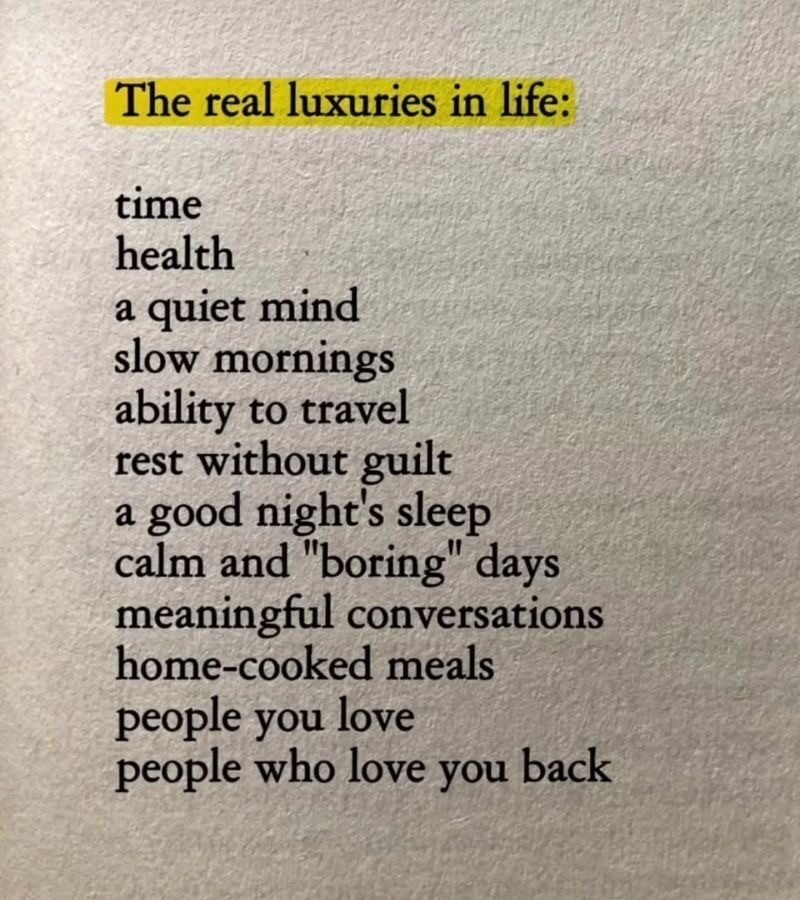
time health a quiet mind slow mornings ability to travel rest without guilt a good night's sleep calm and "boring" days meaningful conversations home-cooked meals people you love people who love you back

You’re more relaxed

“You’re more relaxed”, says my wife.

And she’s right. I am!

I like my work, and I work hard. It’s just a corporate job, but I enjoy it. I also try to be a good partner, and a good dad. That means co-running the household together with my wife, doing whatever needs to get done. It means helping the kids with their homework and their troubles, listening to them, and just spending time together.

At some point, 24 hours in the day were no longer enough. When the job had eaten its share, I would spend any energy I had left on the kids, and simultaneously try to put the house in order.

I did get time for hobbies every now and then. But frequently I would have a day of whitewater kayaking planned, only to wake up and notice that I really had no juice left, and also a bunch of urgent things at home that needed taking care of. I noticed how I was never quite refreshed after a weekend. I saw a couple of colleagues heading into burnout, and coming back after months, taking on reduced responsibilities.

Some years ago I read a newspaper article from a middle aged dad like myself. He described how he had slowly given up on all the things that gave him joy. How he was working hard to provide for his family, to be available and supportive; but how he felt himself wearing thin. He called this mode of existence the “dad diesel”, running steadily and reliably, without much excitement – until it would break down one day.

When we came back from Christmas break in January, our manager announced that one of my teammates would be working a 4-day week for twelve months. This is a possibility the company offers, so people can try out whether this schedule suits them. Immediately I knew that I wanted this, too. So I looked up the part-time trial scheme, scheduled a conversation with my manager, filled out a few forms, and waited a bit .

Then in March, my four-day week started. Fridays off. And it’s wonderful.

There’s more time to get my housework and parenting done, and then do things for myself. On one of the first free Fridays, I hopped on a train in the morning, rode into the mountains, and took an all-day hike. It felt incredible.

But there’s more to it than just having more time. Going part-time changed the way I look at work. I’ve always been a somewhat competitive person. I want to achieve things. I want to learn and grow, and get recognition. (I’ve since realized that I was probably overvaluing the recognition thing, like so many people do.) I’ve done reasonably well, mainly by working hard. In other words: I was a happy participant in the corporate ratrace.

Reducing my working hours meant bailing out of that game. If I only work four days, it makes no sense to try and out-work those I think I’m competing with. Instead, I now feel that I’m working to live. I still like my job, and find it meaningful. But I don’t think about work so much anymore. It’s no longer the main part of my life.

For me, this is enormously liberating. I hardly ever feel really stressed now. Even when things get hectic at work – and they do -, I’m usually quite chill. It’s just work, nothing personal. To some, this might have always been obvious. To me, it was a revelation.

At the same time, my wife and kids notice that I’m much more available and attentive. There’s less arguing in our house now, and more quiet, flowing conversations. The pressure is off.

All this is easily worth the 20% of my salary that I’m forgoing. We’re fortunate to have enough money to get by without worrying much. The old car will need to live a bit longer, but nobody minds. The kids are getting older, and if they want money for fancy clothes or other stuff, they can go get a job. We weren’t vacationing in the Caribbean before, and camping at the beach in Croatia will continue to do fine for us.

Soon the time will come for me to decide whether I want to make that four-day week permanent. I’ve been thinking, and the answer is yes.

Sea kayaking in Croatia

Our summer vacations in Croatia typically consist of camping on one of the country’s beautiful islands, while doing as little as possible.

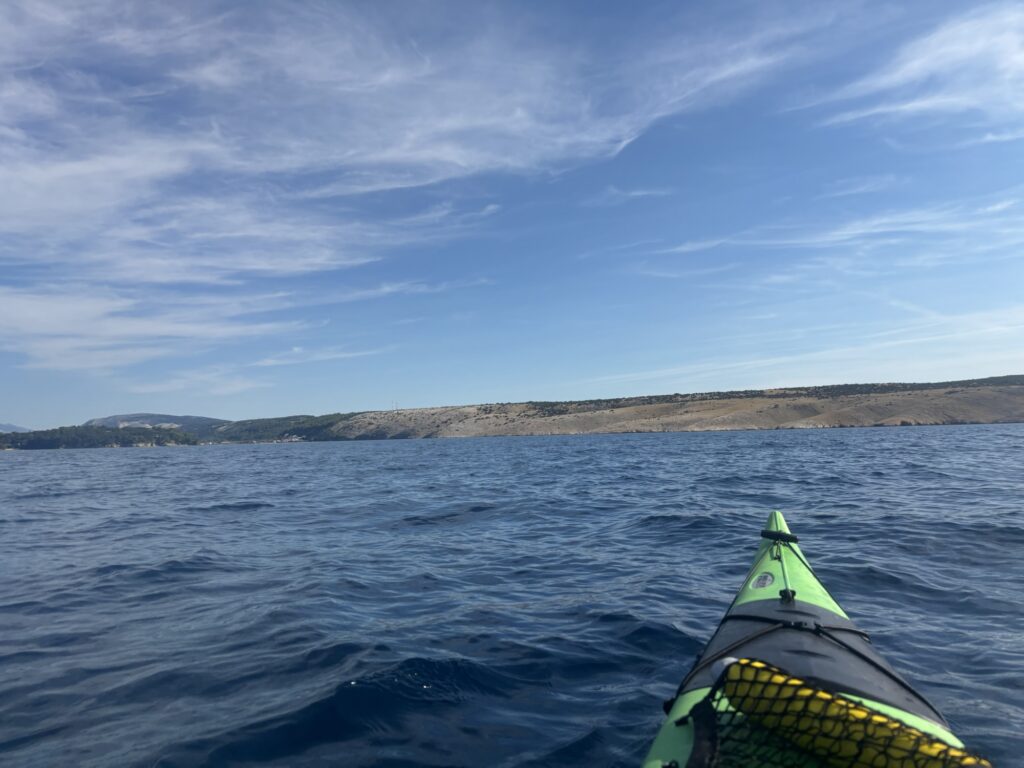
But I got a sea kayak last year, and this is a great area for it. Clear turquoise water, mostly calm seas, lots of little beaches everywhere. Just perfect. So, once I felt I’d gotten enough rest and wanted some action, I took the kayak for a little overnight trip.

View of the sea, shot over the bow of a green sea kayak

I’m still gathering experience with this sort of thing. Wanting to travel as light as possible, I took just the basics:

  • a light sleeping bag
  • a hammock (the ground around here tends towards the spiky, and it’s hard to find a level patch
  • bottled water for two days, six liters in total
  • camping stove
  • food: instant ramen, instant porridge, instant coffee, and a few muesli bars
  • a shirt, plus a down jacket just in case

I had to wait a few days for the right combination of stable weather and the absence of social events. When the window came, I started in the afternoon, when the heat had let off a little. Paddled along the coast for three hours. I’m a fairly novice sea kayaker, but I’ve had my butt kicked by enough whitewater rivers to deeply respect the water. So I wore a PFD (life jacket), and stuck close to land for the most part. I should probably take a few trips with more experienced paddlers to learn their ways…

There were plenty of little pleasure boats out there, but they left me alone. At a few points along the way, when rounding a cape, the wind and wave situation changed. That sometimes felt stressful, even though I certainly wasn’t in danger of flipping. Still, it was a bit of a mental challenge. (I can roll a kayak fine, but I’d prefer not to test this in open water with a boat filled with luggage.)

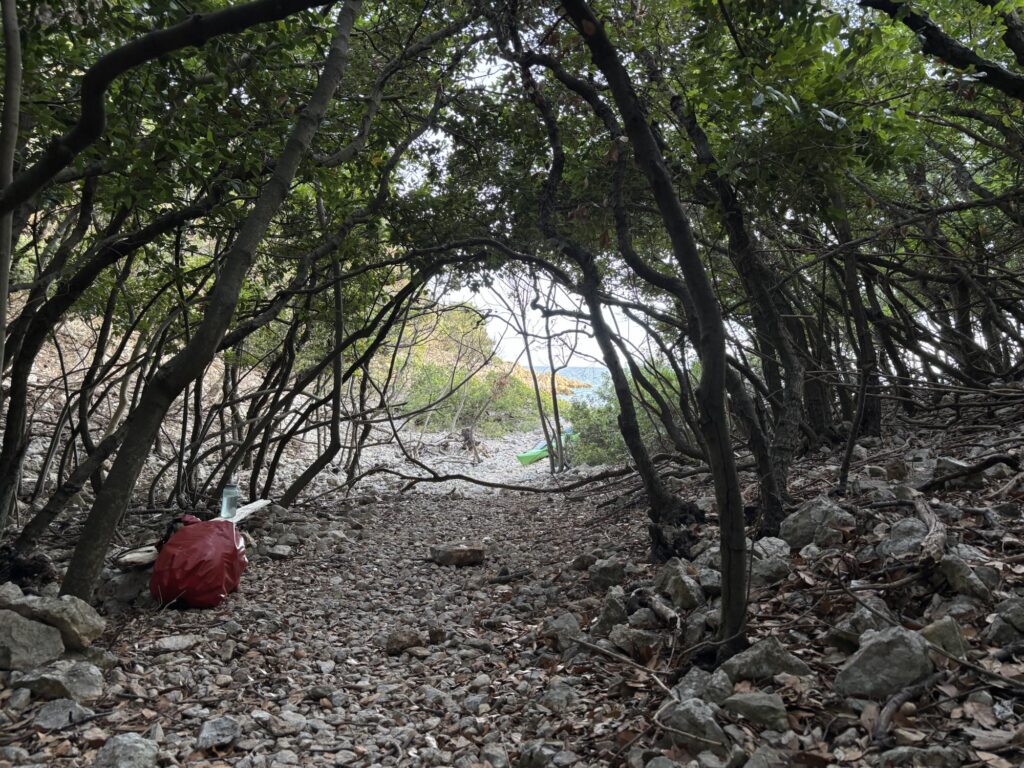
In a low forest, looking out toward the sea

I saw quite a few animals. Glistening swarms of sardines jumping. Various seagulls and other birds. A flying fish – something I’d never seen before. And, as the high point, dolphins!

One dolphin surfaced maybe 20 meters from my boat. I noticed it when it made a noise that frankly sounded a bit rude. It swam in parallel with me for a minute or two, surfacing periodically and breathing. Amazing! Later, I saw some more dolphins, jumping and playing. They were quite far away though, at least 500 meters.

Around 18:30, the wind picked up a bit, and I was on a more exposed part of the coastline. I still had a bit of a way to my intended night spot. But the wind and the waves were pushing me towards the shore, which was lined with rows of very pointy rocks. Also, I was getting tired.

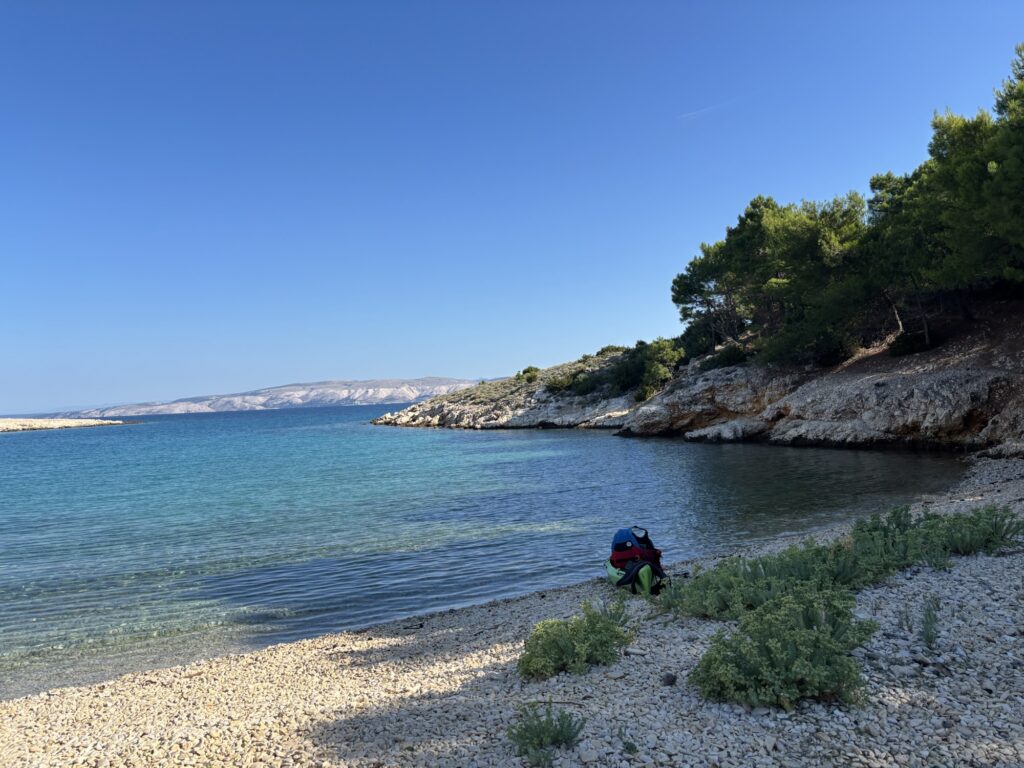
So I decided to play it safe, and pulled into the first little bay that presented itself. It turned out to be a good choice! It was lonely, and behind the immediate beach, there was a little depression. So I landed, hid the boat in the depression, and looked for a place to discreetly string up my hammock.

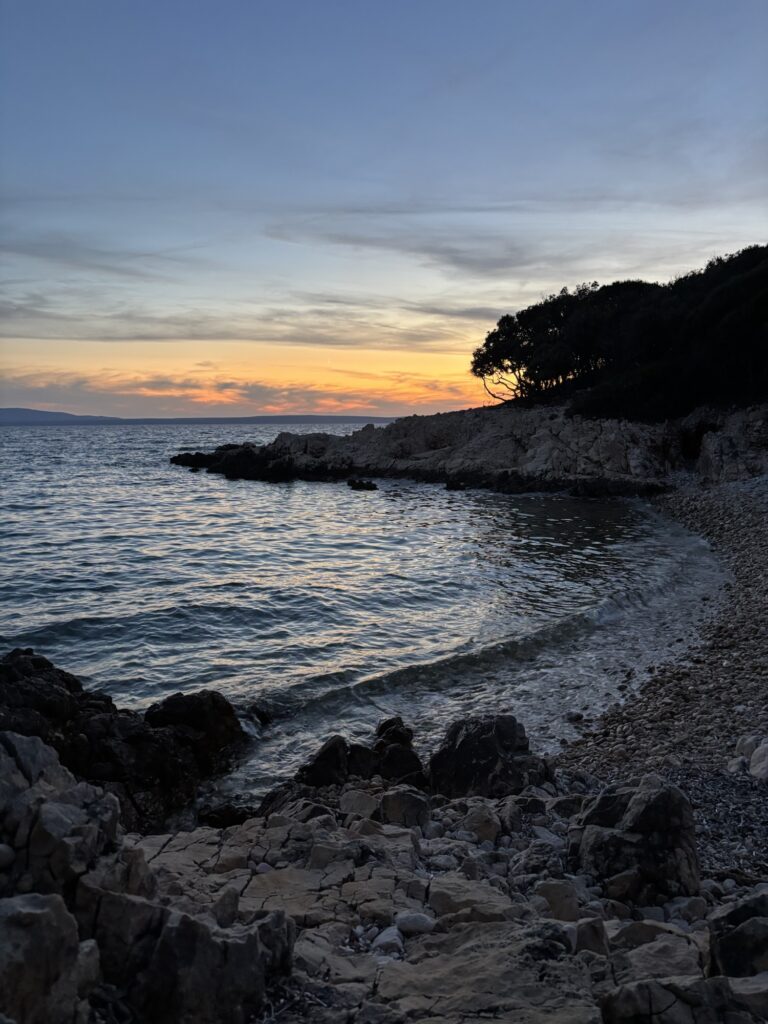
Sunset over a rocky beach

Why the secrecy? Well, this is a touristy area, and the Croatians have wisely decided to ban wild camping. So I tried to avoid being seen, but a few boats did pass by that probably noticed me.

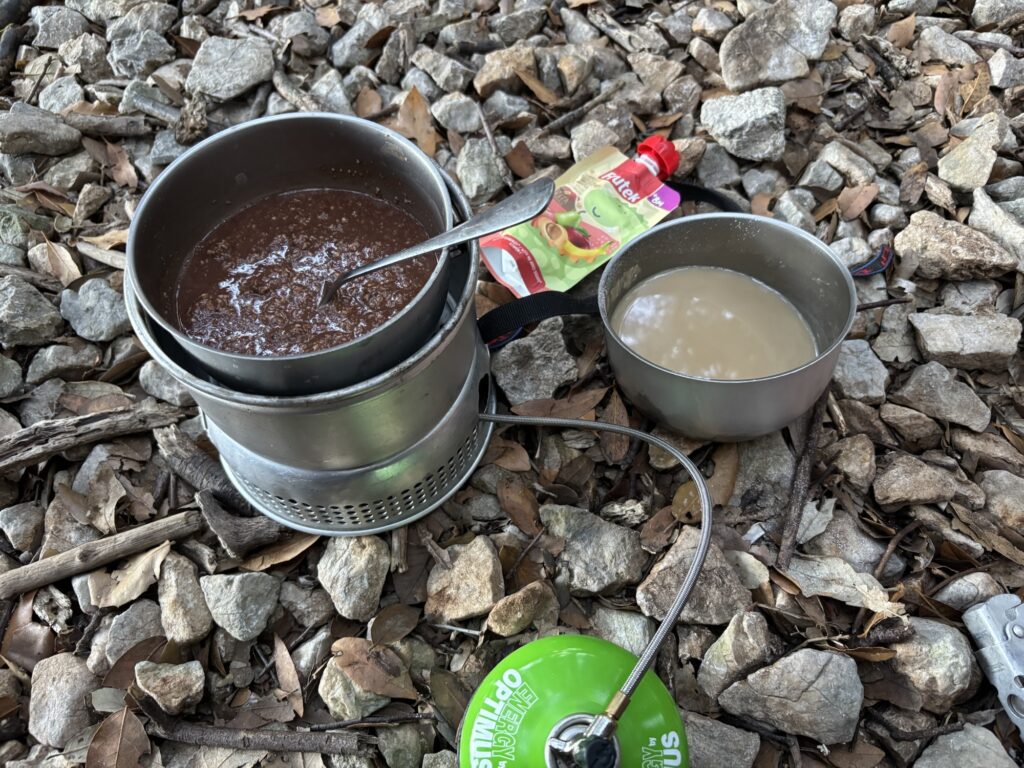
A Trangia camping stove, with chocolate porridge bubbling in the pot

I made my dinner, and watched the sunset on the beach. It was a clear night, and the stars were beautiful! Eventually, I retired to my hammock.

The night was a bit shit. I was woken up around 2am by a motor boat that was passing very slowly, shining a questioning light in my direction. Either one of the boats from earlier had ratted me out, or it was a routine inspection. In either case, I felt a little paranoid. The boat left eventually, though — only to come back two hours later.

Hammocks aren’t great for sleeping in, and it was getting cold by now. Add the excitement of hiding from the rangers, and the whole affair wasn’t very restful. In the end, I put on my down jacket and crawled back into the sleeping bag for another couple of hours.

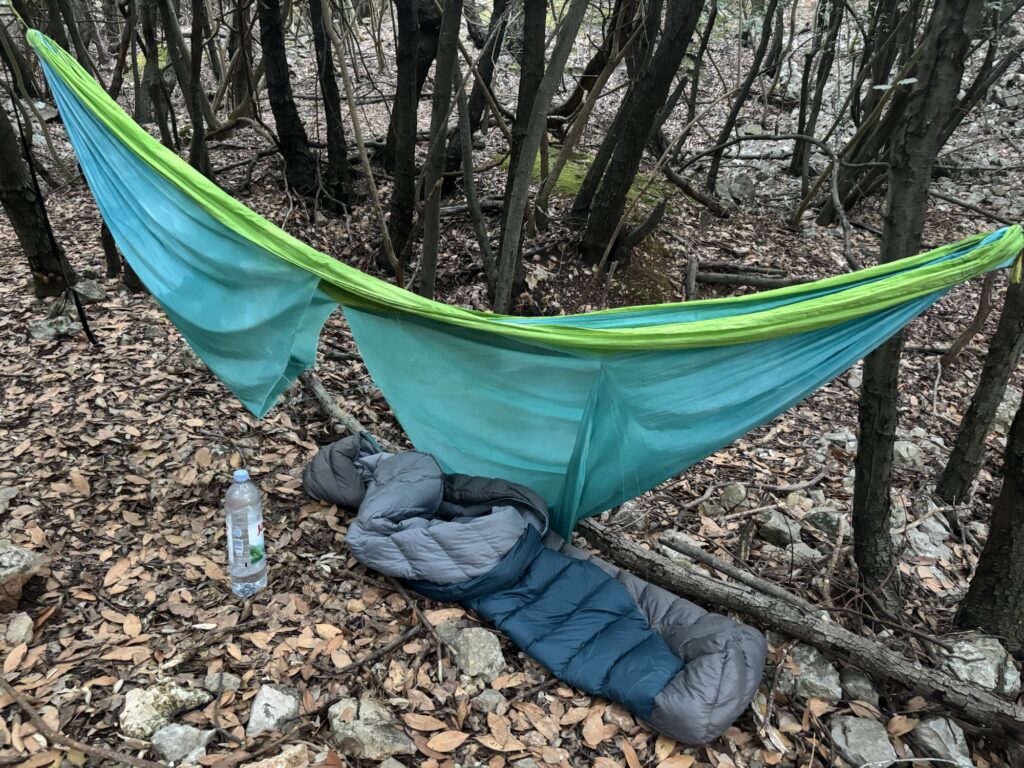
A sleeping bag lying on the ground, underneath a ripped hammock

Around 7am I was debating whether to get up, or try to sleep some more, when my hammock made the decision for me, and simply ripped apart under me, lowering me gently to the ground. So I got up, had a little swim, and made breakfast.

Striking camp was a quick process. Of course, I made sure to take all my trash, and leave no trace behind. Then I got into my boat, and went back the way I had come.

The night took its toll, and I had to take a break every hour or so, seeing a few more lovely beaches. When I arrived home, I dropped into the family hammock, and enjoyed some well-deserved rest.

Finding the sun

(February 2025)

It’s been grey and overcast here for a while. Last Saturday I simply couldn’t take it anymore. Something had to be done! So I put on my hiking boots, and went up a mountain. If the sun didn’t come to me, I would just have to go and
find the sun!

The Brünnstein is a not-terribly-high mountain nearby, peaking at 1634m. I picked it because a) I hadn’t been there before, and b) the relevant apps offered a tour that looked
like what I wanted.

When I parked the car at the trailhead, everything was still depressively grey. Not so much weather, more like an absence of weather. The path soon led me into the forest, and took on a substantial grade.

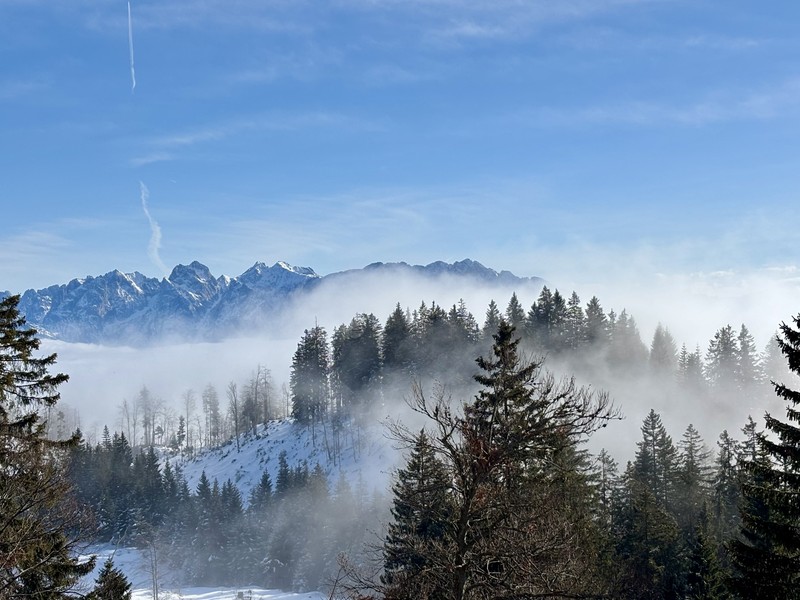
There was still a lot of snow on the ground, and I was happy to have my trekking poles. The forest felt a little mysterious. Finally, I approached the upper edge of the fog that’s been plagueing us for weeks:

Hiking into the sunlight was magical. The rays on my face felt great after such a long time. And the view above the clouds was beautiful:

There are two routes to the summit. One is a very easy via ferrata. I had brought a band sling and a couple of carabiners, so I could improvise a climbing harness. But I’m not a very experienced mountaineer, and all that snow on the ground didn’t inspire confidence.

So I decided to save the via ferrata for spring, and took the easier — if slightly longer — path to the summit. This turned out to also be something of a climb. Not really dangerous or difficult, but interesting enough that the local hiking club had fixed a bunch of substantial steel cables to the rocks,
so climbers could secure themselves.

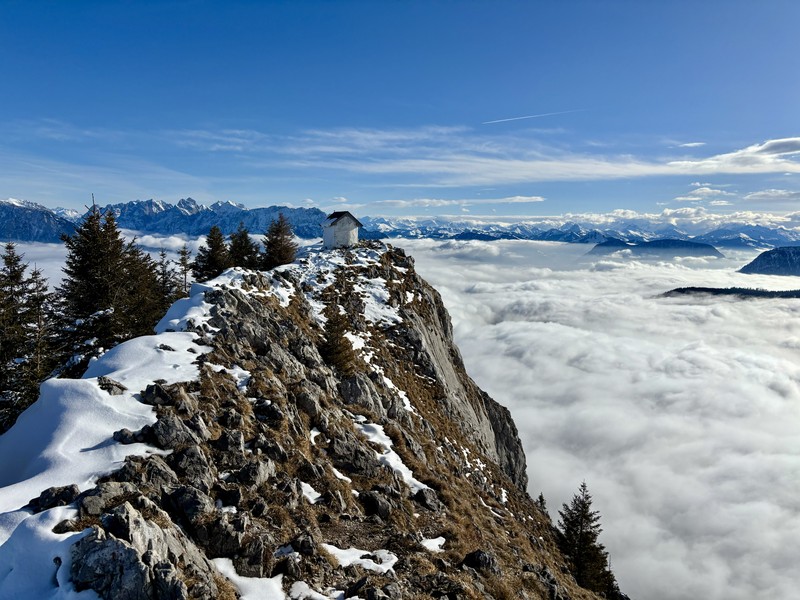
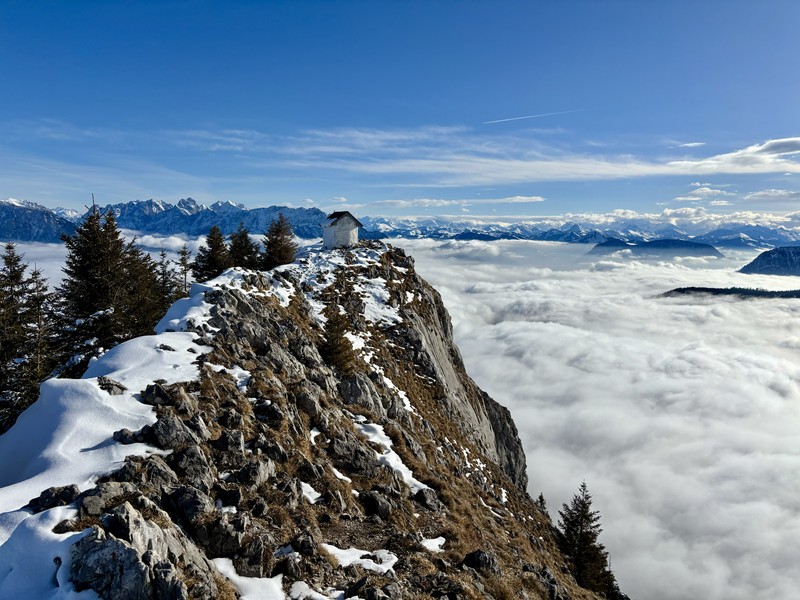
Arriving at the summit was just perfect. I mean, look at this view!

The mountain has two peaks. The one that’s visited most is what you see in the picture, just by the little chapel. The actual, slightly higher peak (by maybe 2 meters, if that) is a little away over a ridge. I dithered whether I should
risk the snow-covered, narrow ridge. In the end I decided that I would be really annoyed with myself if I didn’t. So I went, and it was fine!

I went home the way I had come. Only much happier. Mountains are good for the soul.